
Shopping Cart
There are no more items in your cart
 Español
 English
 Português PT
 Français
 Italiano
 Deutsch
 اللغة العربية
In a nutshell: Building a quiet PC requires balancing airflow and static pressure using 120 mm or 140 mm fans running below 1,200 RPM, while maintaining a positive pressure setup to prevent dust build-up and acoustic turbulence.
Table of contents
- Which parameters define a fan's performance?
- Positive or negative pressure: which is quieter?
- How do you calculate airflow and balance the case?
- Which fan size should you choose: 80 mm, 120 mm or 140 mm?
- Selection criteria before buying components
- Comparison of silent cooling models
- What are the most common mistakes when setting up airflow?
- FAQs about silent cooling
- Final verdict
Which parameters define a fan's performance?
To set up near-silent cooling, you need to measure and distinguish three technical concepts:
- Airflow (CFM): The volume of air moved, measured in cubic feet per minute (Cubic Feet per Minute). An airflow of 48.12 CFM to 50 CFM is sufficient to renew the air inside the chassis without generating excessive noise.
- Static pressure (mmH2O): The fan's ability to push air against physical resistance (dense dust filters, restrictive grilles or radiators). A pressure of 1.47 mmH2O allows air to pass through filters while keeping noise levels low.
- Noise level (dBA): The sound pressure perceived by the human ear according to the A-weighting scale. A value of 14 dBA is considered practically inaudible at a distance of 1 metre.
Airflow and static pressure are not interchangeable figures: a fan with 50 CFM but low static pressure will lose up to 60% of its performance if installed right up against a tightly woven grille or a liquid cooling radiator.
Positive or negative pressure: which is quieter?
The relationship between the air drawn in (intake) and the air expelled (exhaust) determines the acoustics and internal cleanliness of the system.
POSITIVE PRESSURE NEGATIVE PRESSURE
┌─────────────────────────────┐        ┌─────────────────────────────┐
│ Intake > Exhaust            │        │ Exhaust > Intake            │
│  [+] Filtered air comes in  │        │  [-] Air enters through gaps│
│  [+] Dust does not get in   │        │  [-] Draws in dust          │
│  [+] Fewer turbulence       │        │  [-] More friction noise    │
└─────────────────────────────┘        └─────────────────────────────┘
- Positive pressure (recommended for silence): More filtered air is drawn in than expelled. This prevents dust from entering through the gaps and PCIe expansion slots, reducing the need for fans to run at 100% of their speed due to dirt build-up on the heatsinks.
- Negative pressure: More air is expelled than actively drawn in. This causes unfiltered air to enter through any opening in the chassis, generating aerodynamic whistling and quickly accumulating dust.
How do you calculate airflow and balance the case?
To guarantee positive pressure and keep revolutions below 1,200 RPM, the total airflow of the front fans must exceed that of the rear and top fans.
For example, if you install 2 front fans of 48.12 CFM drawing air in and 1 rear fan of 48.12 CFM expelling it, the balance works out at 48.12 CFM × 2 = 96.24 CFM of intake versus 48.12 CFM of exhaust, generating positive pressure with a net difference of 96.24 CFM - 48.12 CFM = 48.12 CFM.
If you add a top exhaust fan of 30.5 CFM, the intake still dominates: 96.24 CFM versus 48.12 CFM + 30.5 CFM = 78.62 CFM of exhaust, maintaining a net positive pressure of 96.24 CFM - 78.62 CFM = 17.62 CFM.
Which fan size should you choose: 80 mm, 120 mm or 140 mm?
The blade diameter has a direct influence on the rotational speed needed to move the same volume of air:
- 140 mm: Moves more airflow at fewer revolutions per minute compared with smaller formats. It is the quietest option for spacious cases.
- 120 mm: This is the industry standard format. It offers an optimal balance between case compatibility, static pressure and contained noise levels.
- 80 mm and 90 mm: These need to spin at higher speeds (between 1,350 RPM and 1,800 RPM) to reach airflows of 25 CFM to 30.5 CFM. They are reserved for compact or secondary cases.
Selection criteria before buying components
To build a silent system, review these technical aspects before choosing components:
- Current draw and power consumption: A fan drawing 0.12 A or 0.15 A consumes less than 2 W on the 12 V line, allowing multiple units to be connected to the same header on the motherboard without overloading it.
- Power supply efficiency: Residual heat inside the case forces the fans to speed up. A PSU such as the Tacens Radix range with 80 PLUS Gold certification reduces energy loss as heat by exceeding 90% energy efficiency at half load.
- Markings and regulations versus quality certifications:
- CE and RoHS: These are mandatory safety declarations and directives, and substance restriction rules for selling in the European Union. They do not certify technical quality or acoustic silence.
- 80 PLUS (CLEAResult) and Cybenetics (ETA / LAMBDA): These are independent voluntary certifications that verify energy efficiency and real noise levels under laboratory testing.
- TÜV Rheinland: An independent voluntary certification for electrical safety.
Comparison of silent cooling models
The following table summarises the airflow, speed, pressure and noise level specifications of different PC fans:
| Model | Dimensions | Blades | Speed | Airflow | Static pressure | Noise level | Current draw |
|---|---|---|---|---|---|---|---|
| AF12 | 120 × 120 × 25 mm | 9 | 1,200 RPM (+10%) | 48.12 CFM | 1.47 mmH2O | 14 dBA | 0.15 A |
| AURAII12 | 120 × 120 × 25 mm | 7 | 1,200 RPM | 50.00 CFM | — | — | — |
| AF8 | 80 × 80 × 25 mm | 7 | 1,800 RPM (+10%) | 30.50 CFM | 1.25 mmH2O | 14 dBA | 0.12 A |
| AURAII9 | 90 × 90 × 25 mm | 7 | 1,350 RPM | 33.00 CFM | — | — | — |
| AURAII8 | 80 × 80 × 25 mm | 7 | 1,500 RPM | 25.00 CFM | — | — | — |
What are the most common mistakes when setting up airflow?
- Prioritising airflow (CFM) over pressure (mmH2O) behind filters: Installing fans designed purely for free flow behind dust filters restricts the passage of air and raises the overall temperature by more than 8 °C.
- Setting aggressive fan curves: Letting the fans run at a fixed 100% speed when the system at idle only dissipates between 40 W and 60 W generates unnecessary noise above 25 dBA.
- Mistaking the CE marking for a seal of silence: Believing that a product bearing the CE mark guarantees low noise is incorrect; CE only validates compliance with EU marketing regulations.
- Mounting fans facing each other in opposite directions: This creates pockets of stagnant air and turbulence that increase vibration and mechanical noise.
Products mentioned
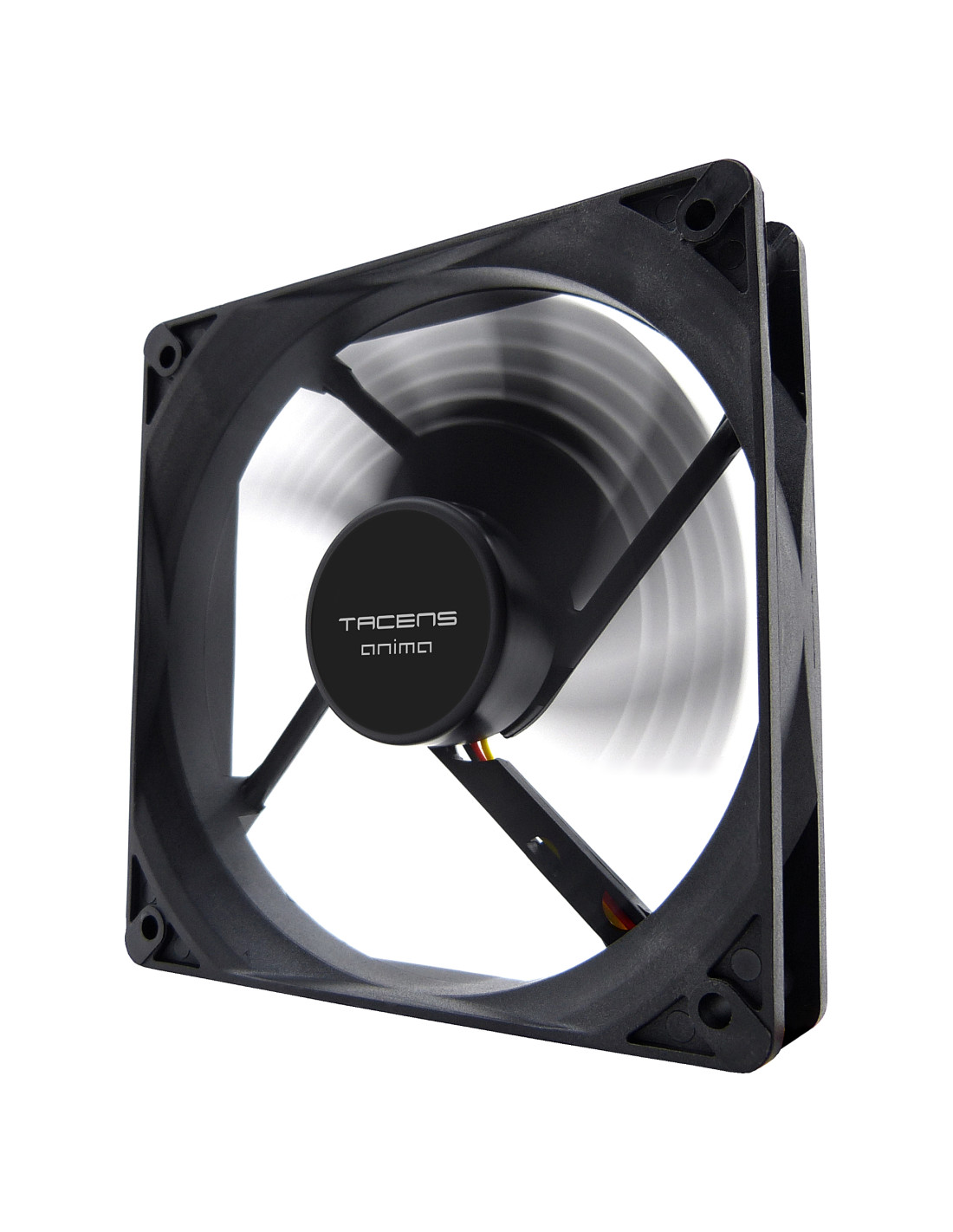
AF12
| Weight | 120g |
|---|---|
| Dimensions | 120x120x25mm |
| Speed | 1200 RPM +10% |
| Airflow | 48.12CFM |
| No. of blades | 9 |
| Noise | 14dBA |
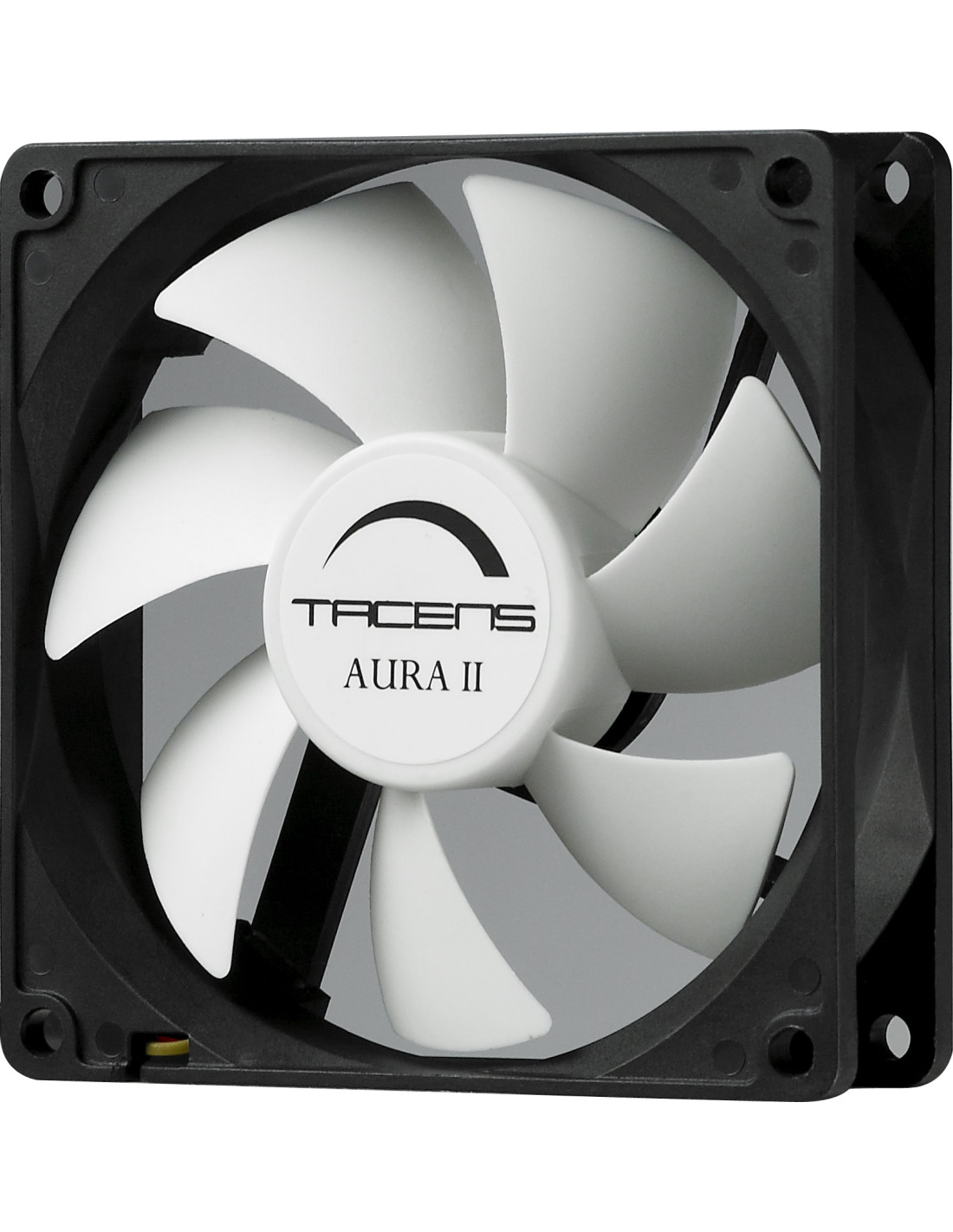
AURAII12
| Weight | 5g 98 |
|---|---|
| Dimensions | 120x120x25mm |
| Speed | 1200 RPM |
| Airflow | 50CFM |
| No. of blades | 7 |
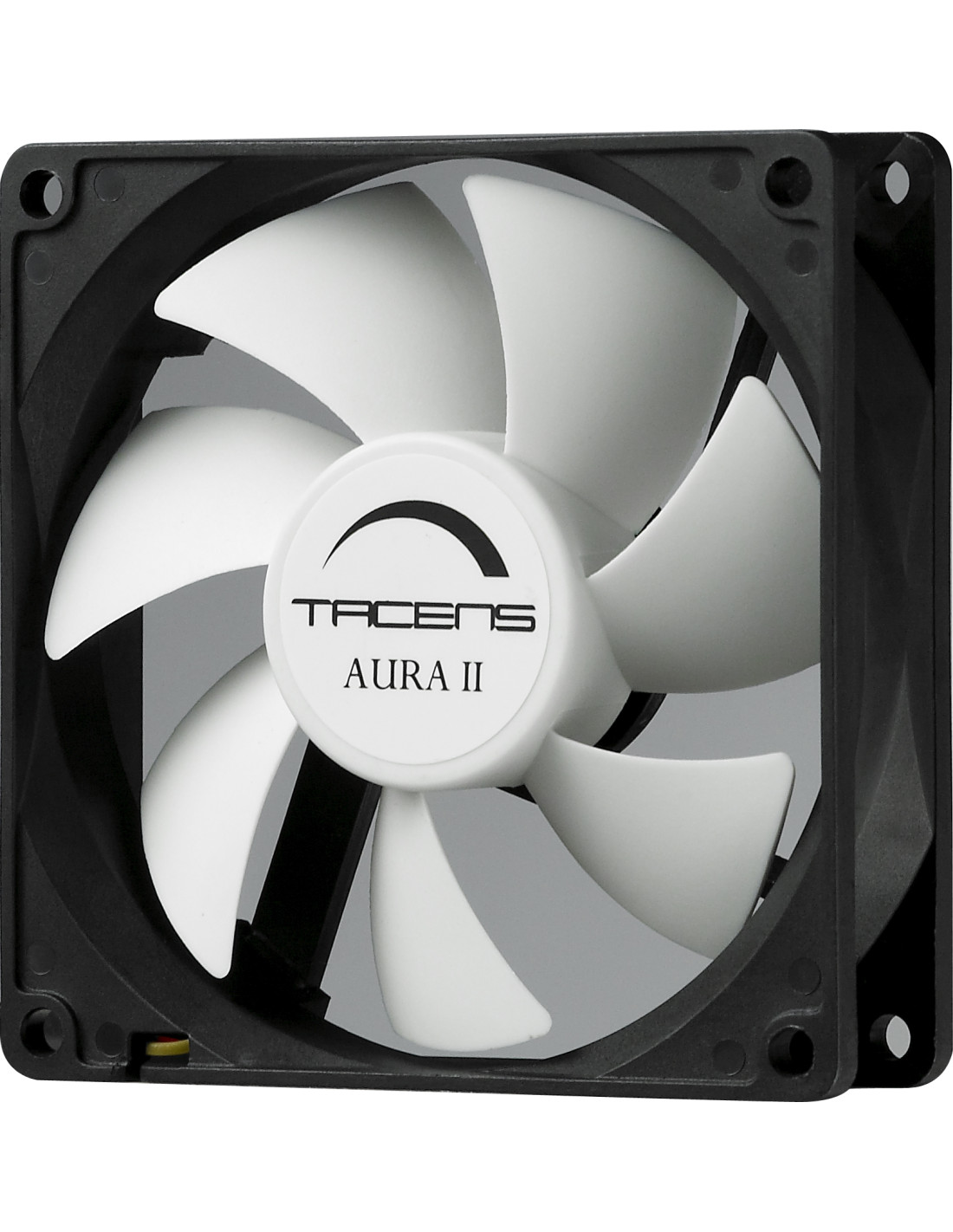
AURAII9
| Weight | 9g 89 |
|---|---|
| Dimensions | 90x90x25mm |
| Speed | 1350 RPM |
| Airflow | 33CFM |
| No. of blades | 7 |
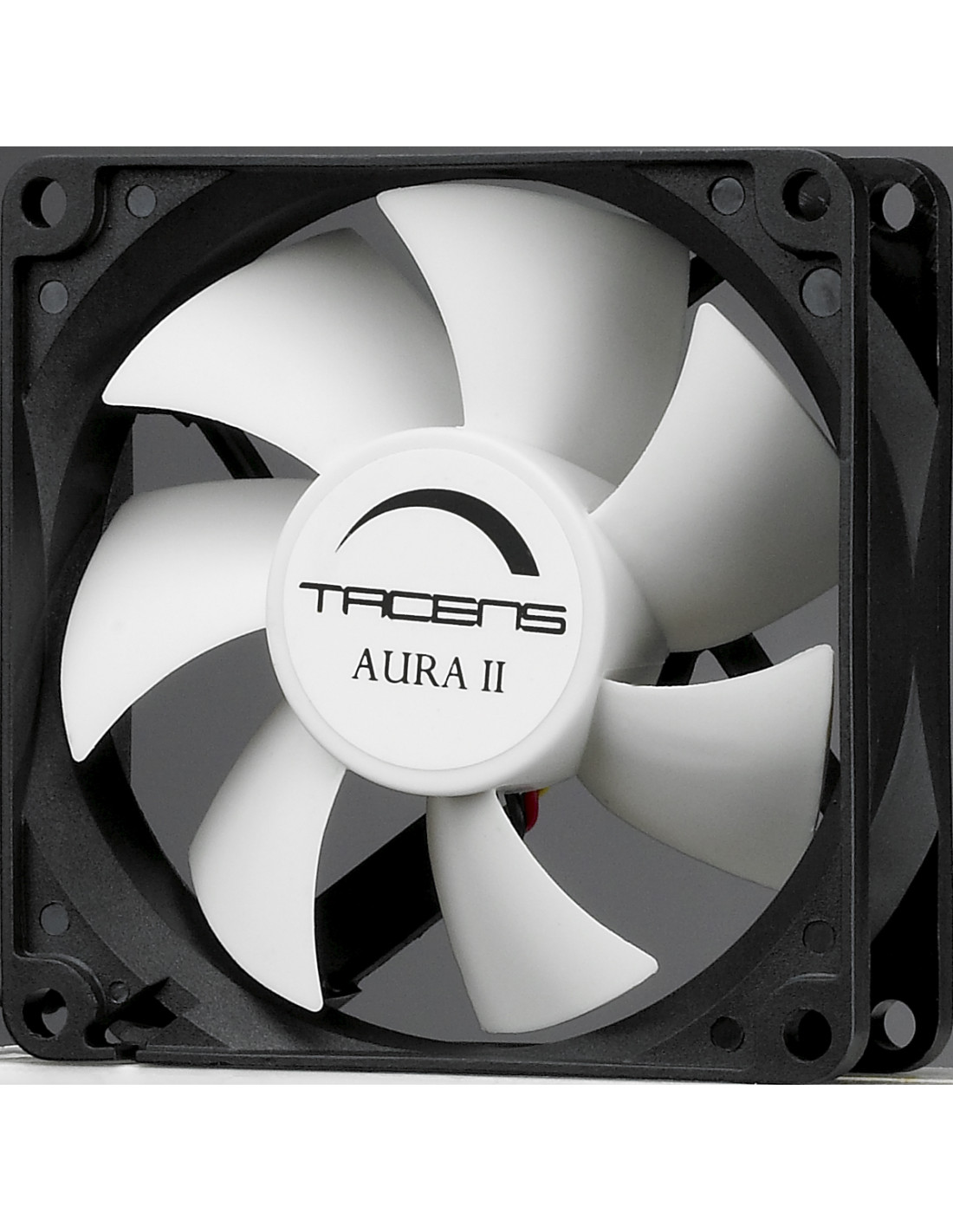
AURAII8
| Weight | 2g 64 |
|---|---|
| Dimensions | 80x80x25mm |
| Speed | 1500 RPM |
| Airflow | 25CFM |
| No. of blades | 7 |
FAQs about silent cooling
How many revolutions per minute should a fan run at to stay quiet?
To keep the noise level below 16 dBA on 120 mm fans, the rotational speed should sit between 800 RPM and 1,200 RPM. Exceeding 1,500 RPM generates aerodynamic turbulence noise that is noticeable in any working environment.
How many fans are needed as a minimum in a case?
A balanced setup requires a minimum of two fans: one front 120 mm fan drawing air in and one rear 120 mm fan expelling it. This arrangement renews the internal air continuously without demanding high rotational speeds.
What is the difference between 80 PLUS certification and the CE marking on a PSU?
The CE marking is a mandatory legal declaration for selling in the European Union and has no bearing on thermal performance. By contrast, 80 PLUS is a voluntary technical certification managed by CLEAResult that audits the electrical efficiency of the PSU to minimise the residual heat emitted into the chassis.
The best: Achieves near-silent operation of 14 dBA with airflows of up to 48.12 CFM by optimising static pressure.
The worst: The compact 80 mm models require 1,800 RPM to deliver 30.5 CFM of airflow.
Buy it if: You want to set up a constant, silent airflow in standard cases with 120 mm fans.
Don't buy it if: You need to cool miniature cases that only accept 80 mm fans operating under sustained high thermal loads.