
Shopping Cart
There are no more items in your cart
 Español
 English
 Português PT
 Français
 Italiano
 Deutsch
 اللغة العربية
In summary: For a quiet case fan, the recommended range sits between 40 CFM and 55 CFM on standard 120 mm models, keeping the speed below 1,200 RPM so as not to exceed 18 dBA or 20 dBA of acoustic noise.
Table of contents
- What do CFM, mmH2O and dBA mean in PC cooling?
- How many CFM are needed depending on fan size?
- How to calculate the total airflow for the case?
- Which technical criteria define a quiet fan?
- What is the real performance of catalogue models?
- What are the most common mistakes when buying fans?
- When should static pressure be prioritised over airflow?
- FAQs about PC cooling
- Final verdict
What do CFM, mmH2O and dBA mean in PC cooling?
Airflow is measured in CFM (Cubic Feet per Minute) and indicates the volume of air the blades move in one continuous minute at 1,200 RPM or at their stated maximum speed.
Static pressure is expressed in mmH2O (millimetres of water column) and measures the force exerted by the air to push through obstacles such as densely meshed grilles or 25 mm thick radiators.
Noise level is quantified in dBA (A-weighted decibels), a scale adapted to the sensitivity of the human ear where values below 15 dBA are considered inaudible in a standard home environment.
How many CFM are needed depending on fan size?
The diameter of the fan directly determines the relationship between airflow and the revolutions per minute needed to move it:
- 80 mm fans: They need to spin at speeds between 1,500 RPM and 1,800 RPM to deliver between 25 CFM and 30.5 CFM, which usually limits their use to compact cases.
- 90 mm fans: They typically operate at 1,350 RPM to generate an average airflow of 33 CFM in slim-profile cases.
- 120 mm fans: They represent the industry standard format; they reach between 45 CFM and 50 CFM at 1,200 RPM with a contained sound output of 14 dBA.
- 140 mm fans: They move more air at fewer revolutions per minute than a 120 mm model, so they tend to be quieter when delivering 55 CFM or more while running below 1,000 RPM.
How to calculate the total airflow for the case?
To keep the internal temperature under control without generating annoying turbulence, the configuration should add up to an intake volume slightly higher than the exhaust volume.
For example, with two front AF12 units at 48.12 CFM and one rear AURAII12 at 50 CFM, the combined total airflow is calculated as 48.12 CFM × 2 + 50 CFM = 146.24 CFM, maintaining positive pressure with 96.24 CFM of intake against 50 CFM of extraction.
If the components' power draw is around 350 W inside the case, a renewed airflow of between 90 CFM and 150 CFM is enough to stabilise the temperature without requiring the fans to exceed 70 % of their rotational speed.
Which technical criteria define a quiet fan?
Before choosing a specific model for the case, four mechanical and electrical parameters need to be assessed:
- Rated rotational speed: Models fixed at 1,200 RPM avoid high-frequency aerodynamic hum without requiring aggressive voltage control curves.
- Blade design: Rotors with 7 blades or 9 blades optimise the distribution of continuous airflow across the 25 mm outer frame.
- Power consumption: A low amperage, such as 0.12 A or 0.15 A at 12 V, allows several fans to be connected to a single motherboard header without overloading the line.
- Minimum static pressure: A value above 1.20 mmH2O is recommended if the fan sits behind a front dust filter.
What is the real performance of catalogue models?
The following table compares the verified technical specifications of the case fans available in the Tacens catalogue:
| Model | Dimensions (mm) | Speed (RPM) | Airflow (CFM) | Noise (dBA) | Pressure (mmH2O) | Blades | Current (A) | Weight (g) |
|---|---|---|---|---|---|---|---|---|
| AF12 | 120 × 120 × 25 | 1,200 (+10 %) | 48.12 | 14 | 1.47 | 9 | 0.15 | 120 |
| AURAII12 | 120 × 120 × 25 | 1,200 | 50.00 | — | — | 7 | — | 98 |
| AURAII9 | 90 × 90 × 25 | 1,350 | 33.00 | — | — | 7 | — | 89 |
| R3AURAII9 | 90 × 90 × 25 | 1,350 | 33.00 | — | — | 7 | — | 89 |
| AF8 | 80 × 80 × 25 | 1,800 (+10 %) | 30.50 | 14 | 1.25 | 7 | 0.12 | 60 |
| AURAII8 | 80 × 80 × 25 | 1,500 | 25.00 | — | — | 7 | — | 64 |
What are the most common mistakes when buying fans?
- Confusing airflow with static pressure: A fan with 50 CFM and low pressure loses more than 40 % of its effective performance if installed against a dense radiator or a clogged filter.
- Assuming CE or RoHS guarantee quality: The CE, RoHS and WEEE marks are mandatory legal regulations in the European Union concerning hazardous substances and waste; they do not certify efficiency, low acoustic noise or mechanical durability.
- Looking for voluntary certifications that do not exist for fans: Standards such as 80 PLUS or the Radix Gold range belong exclusively to power supplies, whereas noise certifications such as Cybenetics LAMBDA or TÜV Rheinland assess component acoustics independently.
- Installing small models at high revolutions: An 80 mm fan at 1,800 RPM delivers 30.5 CFM, whereas a 120 mm model at 1,200 RPM reaches 48.12 CFM while emitting the same nominal level of 14 dBA.
When should static pressure be prioritised over airflow?
High airflow (CFM) is the priority when the fan exhausts air through the rear or top without dense grilles on a 120 mm frame.
Conversely, when the air must pass through front dust filters or narrow-finned heatsinks, a minimum pressure of 1.47 mmH2O such as that of the AF12 is needed to prevent the airflow from dropping sharply.
Products mentioned
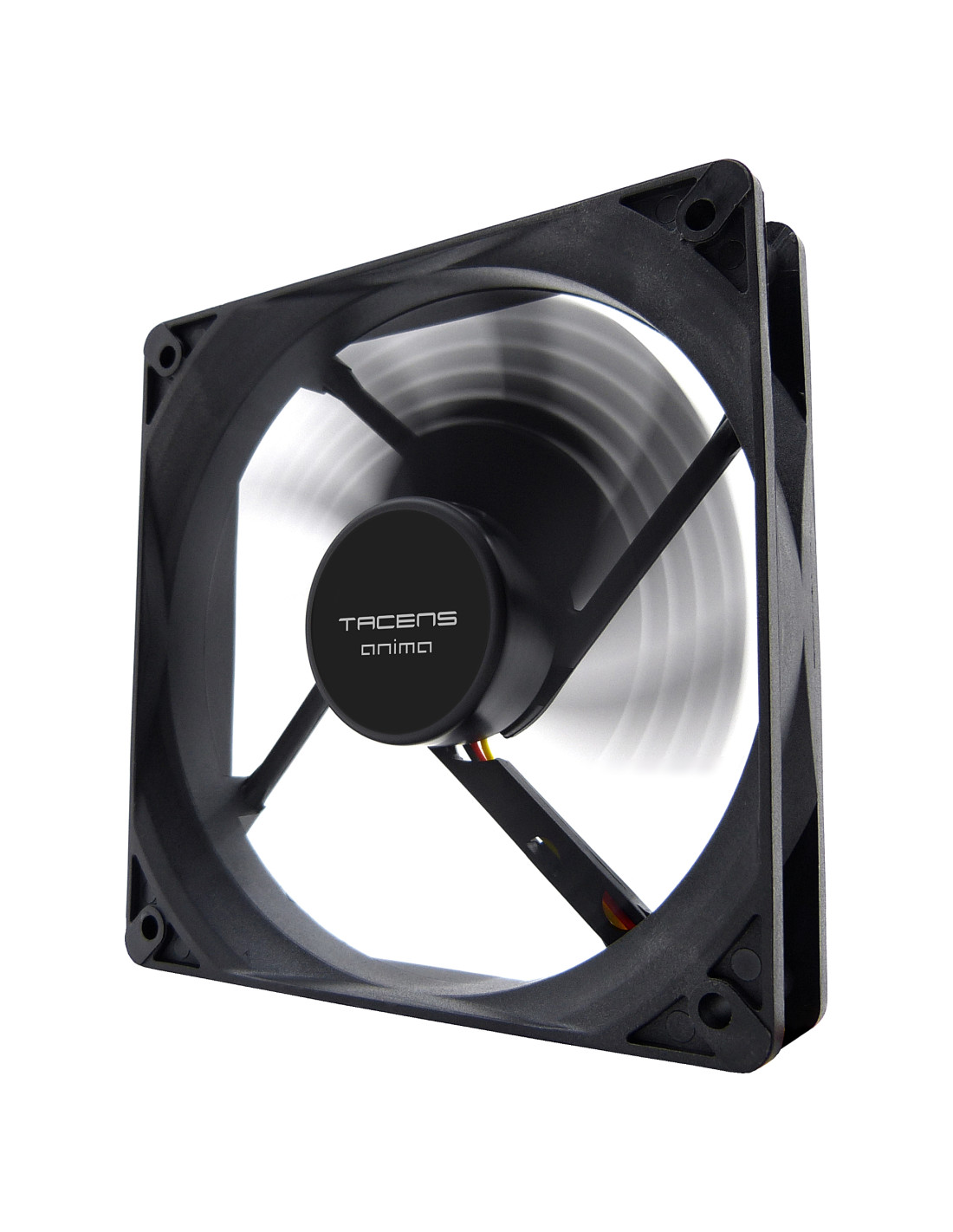
AF12
| Weight | 120g |
|---|---|
| Dimensions | 120x120x25mm |
| Speed | 1200 RPM +10% |
| Airflow | 48.12CFM |
| No. of blades | 9 |
| Noise | 14dBA |
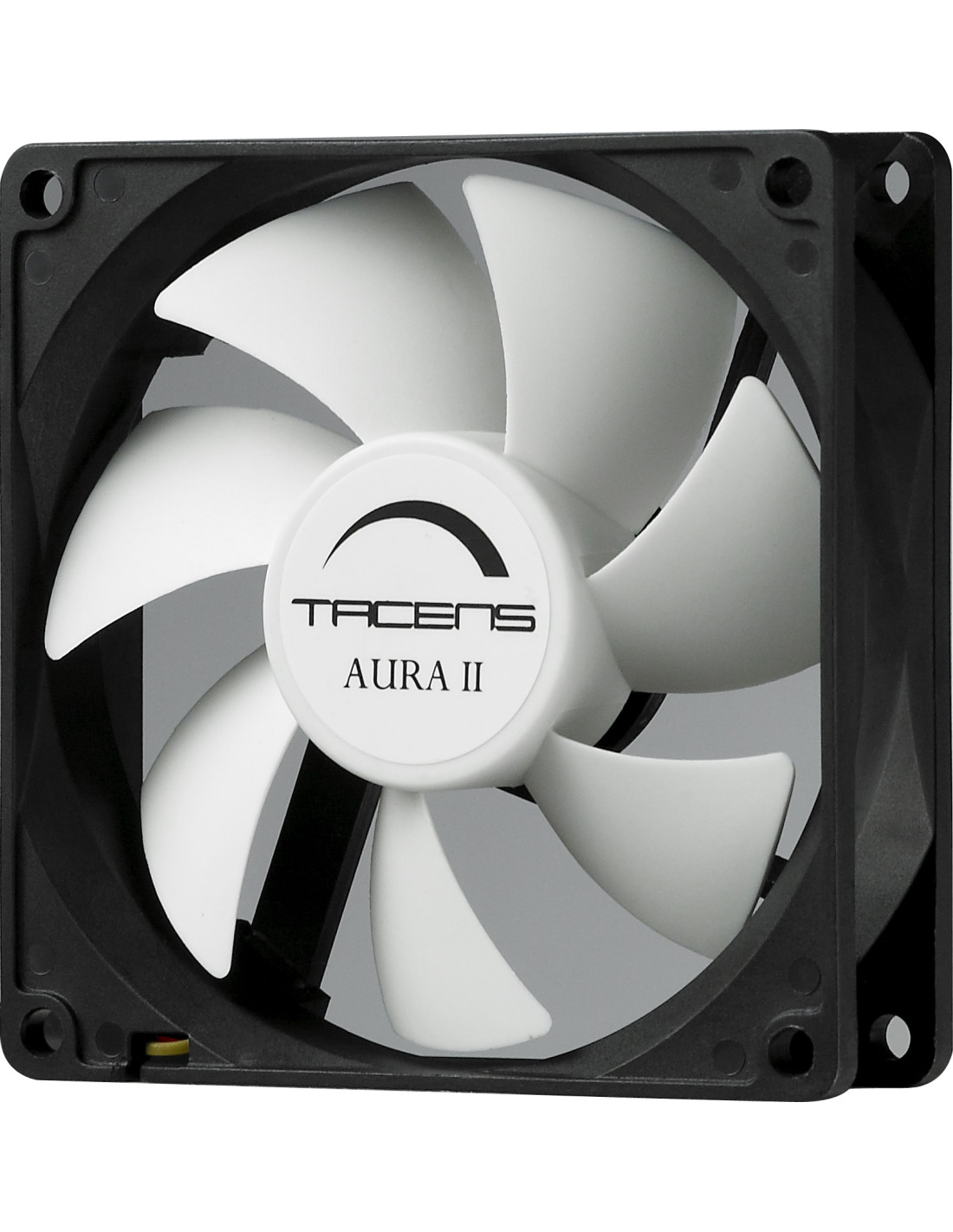
AURAII12
| Weight | 5g 98 |
|---|---|
| Dimensions | 120x120x25mm |
| Speed | 1200 RPM |
| Airflow | 50CFM |
| No. of blades | 7 |
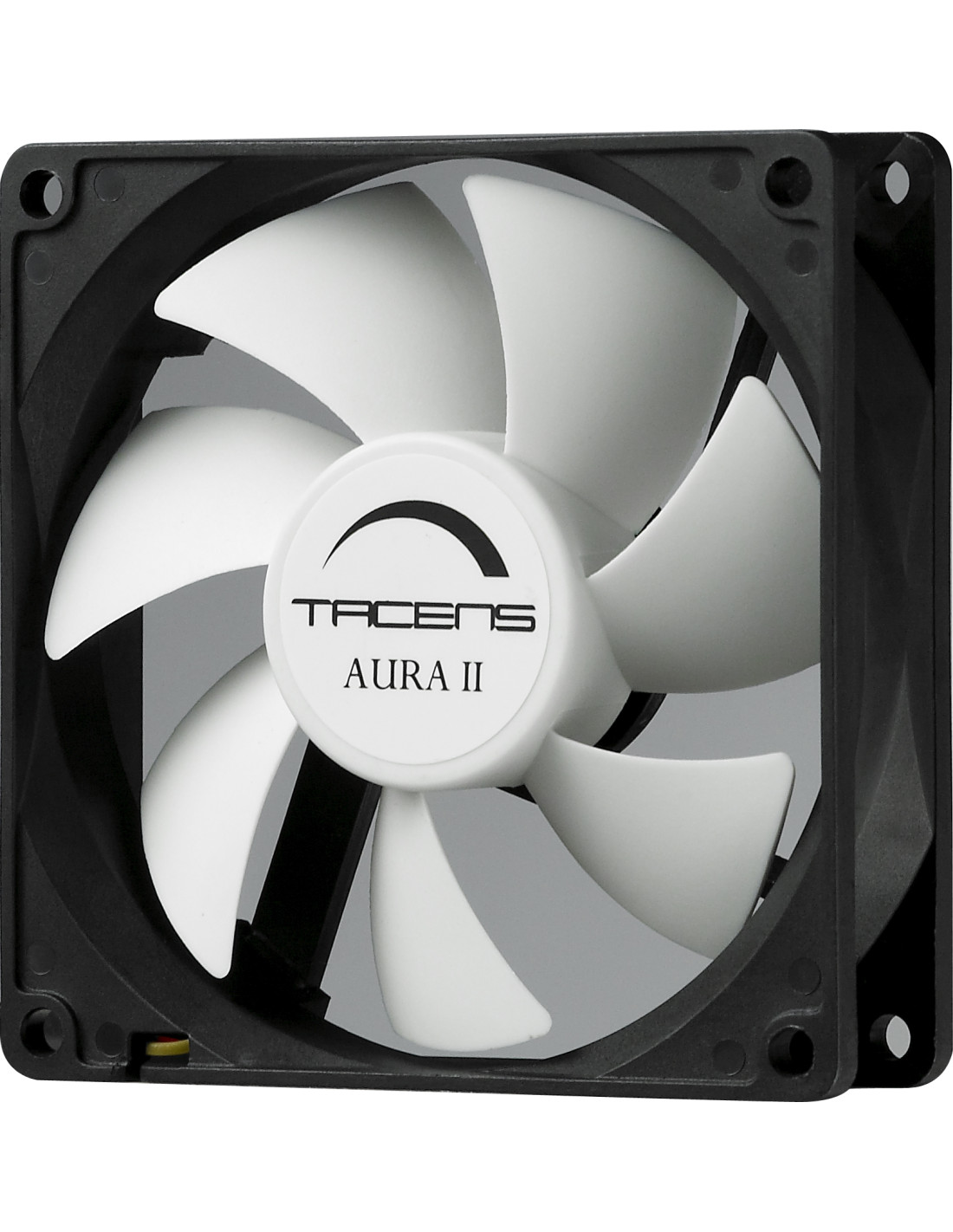
AURAII9
| Weight | 9g 89 |
|---|---|
| Dimensions | 90x90x25mm |
| Speed | 1350 RPM |
| Airflow | 33CFM |
| No. of blades | 7 |
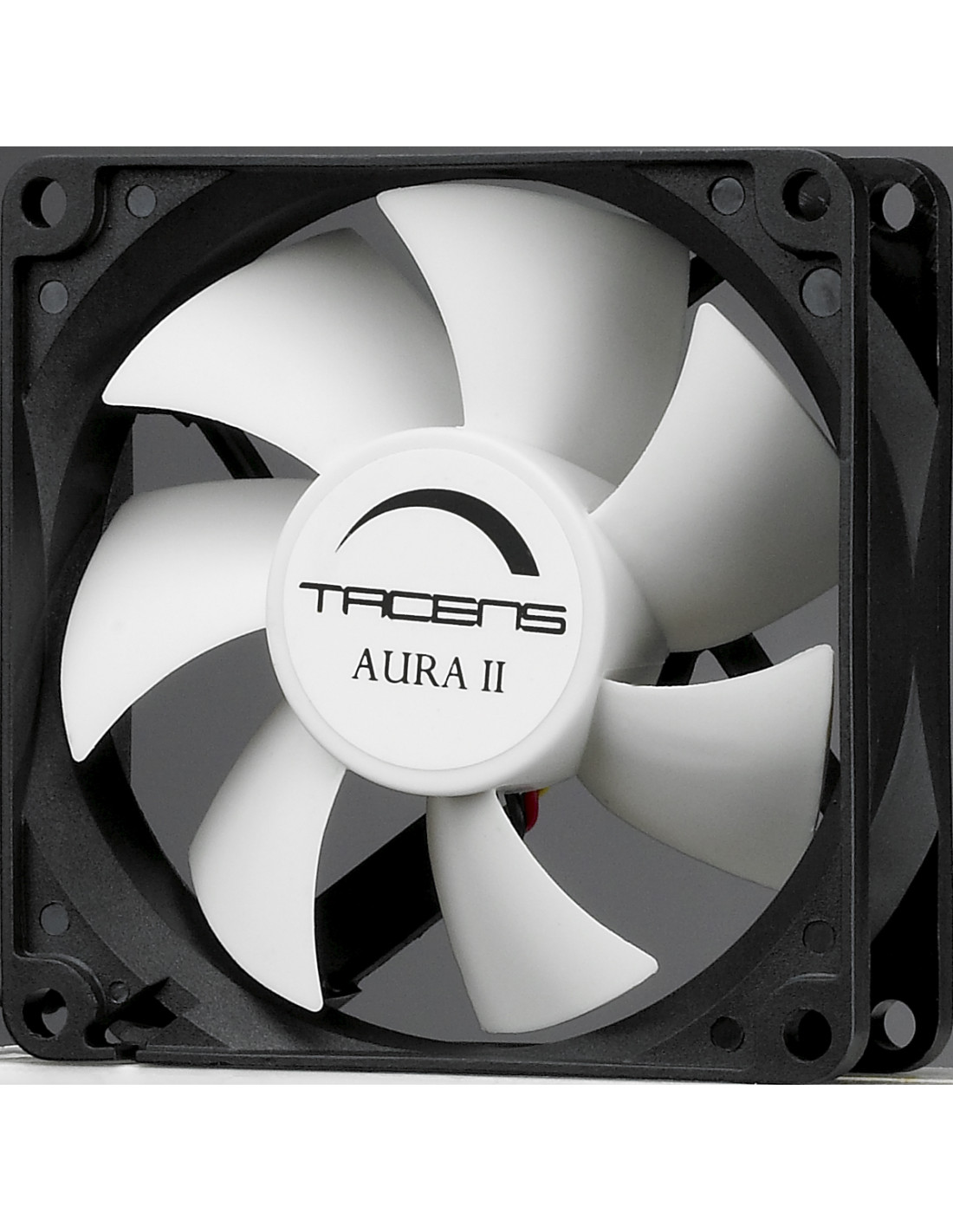
AURAII8
| Weight | 2g 64 |
|---|---|
| Dimensions | 80x80x25mm |
| Speed | 1500 RPM |
| Airflow | 25CFM |
| No. of blades | 7 |
FAQs about PC cooling
Are 48 CFM enough for a standard computer case?
Yes, an airflow of 48.12 CFM at 1,200 RPM provides adequate air renewal for mid-range systems. Two front units with this airflow guarantee an intake of nearly 100 CFM at a sound level of just 14 dBA.
What noise level in dBA is considered truly quiet?
Any figure below 16 dBA is practically imperceptible inside a closed case at one metre's distance. Fans at 14 dBA are masked by the ambient noise of any quiet room.
Is a 120 mm fan or a 140 mm fan better for reducing noise?
The 140 mm model moves a greater volume of air at fewer revolutions, delivering 50 CFM at a lower speed than a 120 mm one. However, if the case only accepts 120 mm, a 9-blade model at 1,200 RPM offers the best balance between 48.12 CFM and 14 dBA.
The best: It delivers an airflow of 48.12 CFM at 14 dBA with solid pressure of 1.47 mmH2O in the standard 120 mm format.
The worst: The 80 mm and 90 mm models are limited to a maximum of 30.5 CFM and 33 CFM owing to their smaller diameter.
Buy it if: You want to cool the case with a steady airflow between 48 CFM and 50 CFM without exceeding 1,200 RPM or generating perceptible noise.
Don't buy it if: You need cooling for a high-density liquid cooling radiator that demands more than 2.0 mmH2O of dedicated static pressure.