
Shopping Cart
There are no more items in your cart
 Español
 English
 Português PT
 Français
 Italiano
 Deutsch
 اللغة العربية
In summary: A compact case generally requires between 1 and 2 additional fans dedicated to extraction in order to renew an internal volume of less than 30 litres and keep component temperatures under control.
Table of contents
- How many extra fans does a compact case need?
- Selection criteria before buying supplementary cooling
- Which metrics define performance in confined spaces?
- How to calculate the required airflow in a small chassis?
- Technical comparison of fans for compact chassis
- Common mistakes when cooling a small-form-factor system
- Which certifications and regulations guarantee electrical safety?
- Frequently asked questions
- Verdict
How many extra fans does a compact case need?
In a chassis with an internal volume of between 10 l and 25 l, the free space for heat dissipation is minimal, so the heat generated by components drawing 150 W to 300 W builds up quickly. Adding 2 additional units — one configured to bring in fresh air (intake) and another to expel it (exhaust) — lowers the internal ambient temperature by between 5 °C and 12 °C compared with a configuration without supplementary cooling.
The determining factor is the pressure balance:
- Configuration with 1 extra fan: It is positioned as an extractor at the rear or top to remove the hot air generated by the CPU cooler and the graphics card.
- Configuration with 2 extra fans: 1 front or bottom unit bringing air in at 48.12 CFM and 1 rear unit expelling it at 48.12 CFM, achieving a constant air-renewal cycle.
- Configuration with 3 extra fans: Recommended only if the graphics card dissipates more than 200 W and the chassis supports side or top mounting of 120 mm fans.
Selection criteria before buying supplementary cooling
Before purchasing any cooling unit, the physical and electrical limitations of the system must be assessed:
- Available space and thickness: Most standard fans are 25 mm deep. In very compact cases, check that they do not interfere with RAM modules or coolers taller than 140 mm.
- Mounting hole diameter: The common mounts in compact cases are 80 mm, 90 mm and 120 mm. A 120 mm model moves more air at lower revolutions than an 80 mm one, with less noise output.
- Type of airflow required: Intake ventilation with dense dust filters demands higher static pressure than an unobstructed rear exhaust.
- Cumulative power draw: Check that the motherboard connectors supply the required current, typically between 0.12 A and 0.15 A per port at 12 V.
Which metrics define performance in confined spaces?
To interpret cooling specifications correctly, it is essential to know the standard units and their definitions:
- CFM (Cubic Feet per Minute): Volumetric airflow in cubic feet per minute. It measures the total amount of air the fan moves without restriction.
- Static pressure (mmH2O or mm-H2O): The ability of the airflow to overcome physical resistance, such as tightly woven filters, restrictive grilles or liquid-cooling radiators. Airflow and pressure are not interchangeable; a fan with high CFM but low pressure performs poorly against a filter.
- dBA (A-weighted decibels): Sound pressure level adjusted to the sensitivity of the human ear. An increase of 3 dBA represents roughly twice the acoustic energy.
- RPM (Revolutions per minute): The rotational speed of the rotor. In 80 mm fans, speeds of around 1800 RPM are typically reached to compensate for their smaller diameter, whereas in 120 mm fans 1200 RPM is enough to achieve a higher airflow.
How to calculate the required airflow in a small chassis?
The calculation of the required airflow is based on the total power draw of the hardware and the extraction capacity of each installed fan.
For example, 65 W of CPU + 160 W of GPU = 225 W of total thermal output, and 225 W × 0.35 CFM/W = 78.75 CFM of overall airflow required to evacuate the heat efficiently.
If an AF12 fan is fitted at the intake providing 48.12 CFM and another AF12 at the exhaust extracting 48.12 CFM, the combined exchange airflow reaches:
Two fans configured as intake and exhaust (push-pull / series) improve pressure and effective airflow by overcoming restrictions, but they do not double the total volumetric airflow passing through the case (the net renewed airflow remains limited by the single-fan flow of ~48.12 CFM).
If the case only accepts smaller 80 mm sizes, two AF8 units provide:
For example, 30.5 CFM + 30.5 CFM = 61.0 CFM, which covers configurations with moderate thermal loads of up to 174 W.
Technical comparison of fans for compact chassis
The following table details the specifications of fans from the Tacens range suited to cases with space restrictions of 80 mm, 90 mm and 120 mm:
| Model | Dimensions (mm) | Speed (RPM) | Airflow (CFM) | Static pressure (mm-H2O) | Noise level (dBA) | Current (A) | Blades |
|---|---|---|---|---|---|---|---|
| AF12 | 120 × 120 × 25 mm | 1200 RPM (+10%) | 48.12 CFM | 1.47 mm-H2O | 14 dBA | 0.15 A | 9 |
| AURAII12 | 120 × 120 × 25 mm | 1200 RPM | 50.00 CFM | — | — | — | 7 |
| AF8 | 80 × 80 × 25 mm | 1800 RPM (+10%) | 30.50 CFM | 1.25 mm-H2O | 14 dBA | 0.12 A | 7 |
| AURAII9 | 90 × 90 × 25 mm | 1350 RPM | 33.00 CFM | — | — | — | 7 |
| AURAII8 | 80 × 80 × 25 mm | 1500 RPM | 25.00 CFM | — | — | — | 7 |
| R3AURAII9 | 90 × 90 × 25 mm | 1350 RPM | 33.00 CFM | — | — | — | 7 |
Common mistakes when cooling a small-form-factor system
- Fitting all the fans in intake mode: This causes hot air to build up inside, as there is no forced escape route, raising the temperature of the VRMs by between 8 °C and 15 °C.
- Prioritising airflow over pressure behind a filter: A 50 CFM model with low static pressure loses up to 60% of its flow when installed behind a dense dust panel. In such positions, a value such as the AF12's 1.47 mm-H2O guarantees the passage of air.
- Mixing sizes without balancing RPM: Placing an 80 mm fan at 1800 RPM extracting against a 120 mm fan at 1200 RPM introducing can unbalance the overall acoustic pressure, generating parasitic noises of more than 20 dBA.
- Neglecting PSU efficiency: Fitting a low-efficiency power supply in a small chassis increases the internal residual heat. Using units with Gold certification, such as the Radix range, reduces thermal losses and the dissipation load placed on the case fans.
Which certifications and regulations guarantee electrical safety?
When selecting fans and power components for compact cases, it is necessary to distinguish between legal obligations and voluntary technical certifications:
- Mandatory regulatory markings in the EU:
- CE: The manufacturer's declaration of compliance with EU directives. It does not certify quality or thermal performance.
- RoHS: Restriction of hazardous substances in electronic components. It is a legal requirement for selling in the EU, not a competitive advantage.
- WEEE: Compliance with waste electrical and electronic equipment management.
- Independent voluntary certifications:
- 80 PLUS: Certifies energy conversion efficiency under the administration of CLEAResult.
- Cybenetics ETA and LAMBDA: Efficiency and noise-level tests across the entire operating load range.
- TÜV Rheinland: Independent testing of electrical safety and electromagnetic compatibility.
Products mentioned
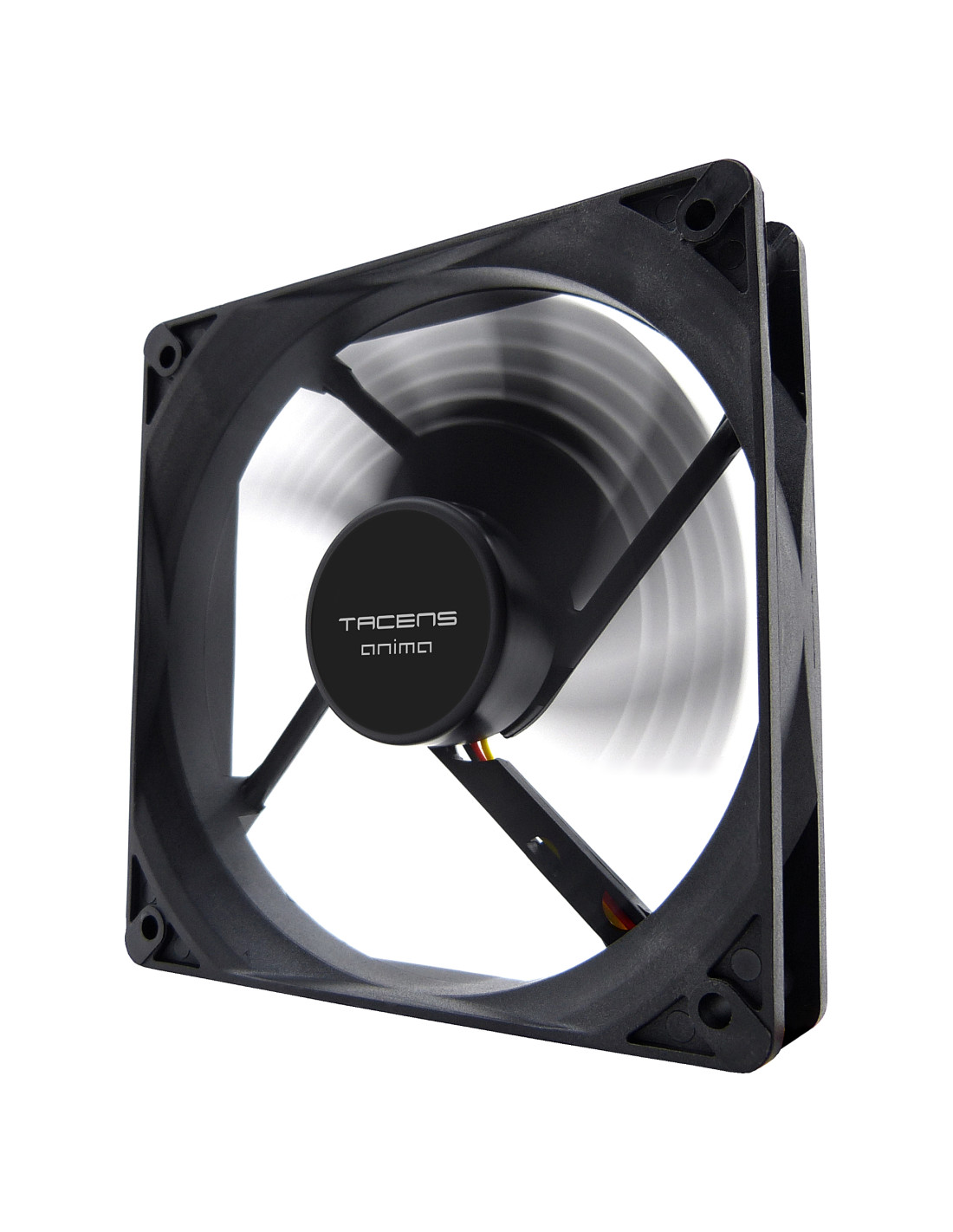
AF12
| Weight | 120g |
|---|---|
| Dimensions | 120x120x25mm |
| Speed | 1200 RPM +10% |
| Airflow | 48.12CFM |
| No. of blades | 9 |
| Noise | 14dBA |
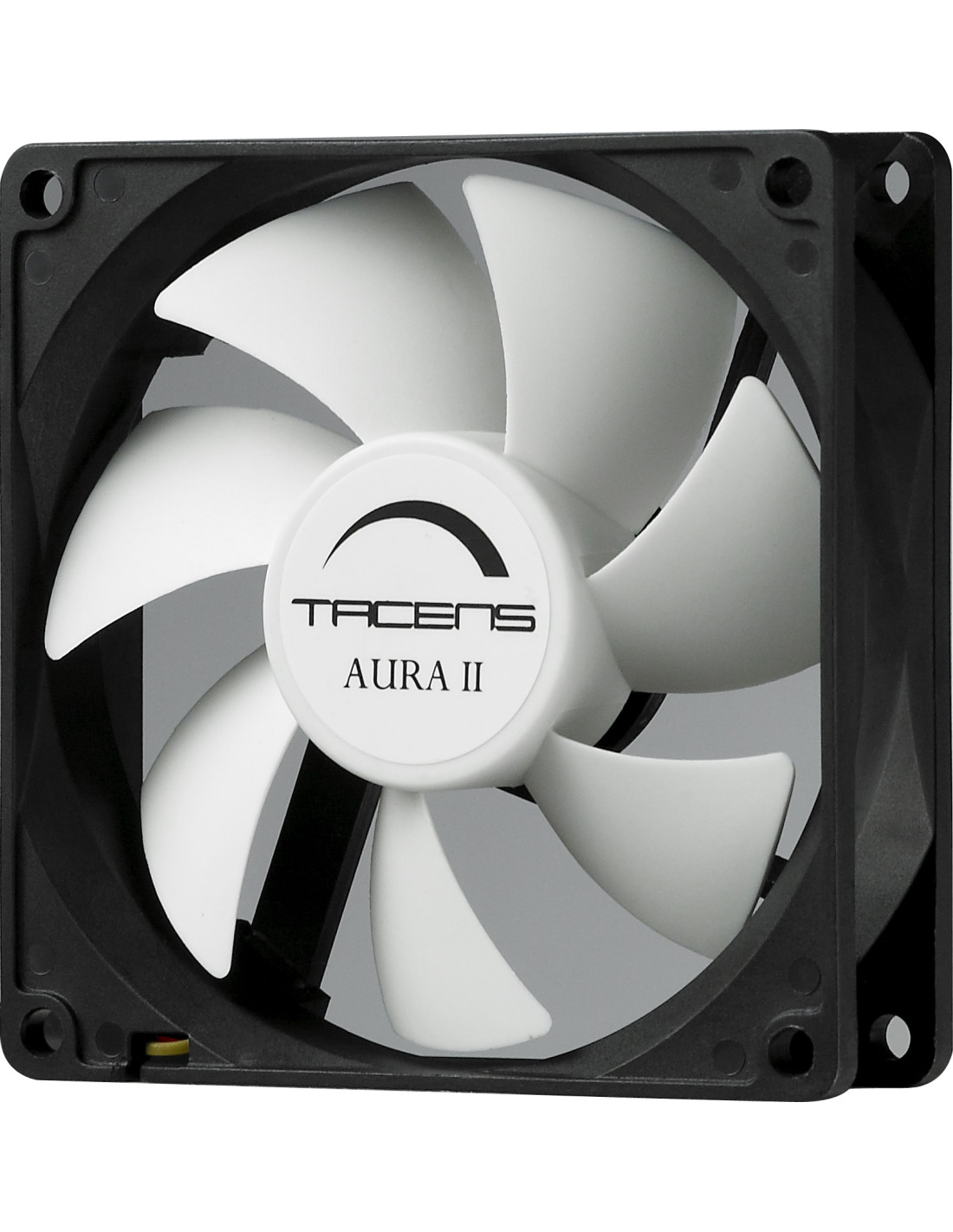
AURAII12
| Weight | 5g 98 |
|---|---|
| Dimensions | 120x120x25mm |
| Speed | 1200 RPM |
| Airflow | 50CFM |
| No. of blades | 7 |
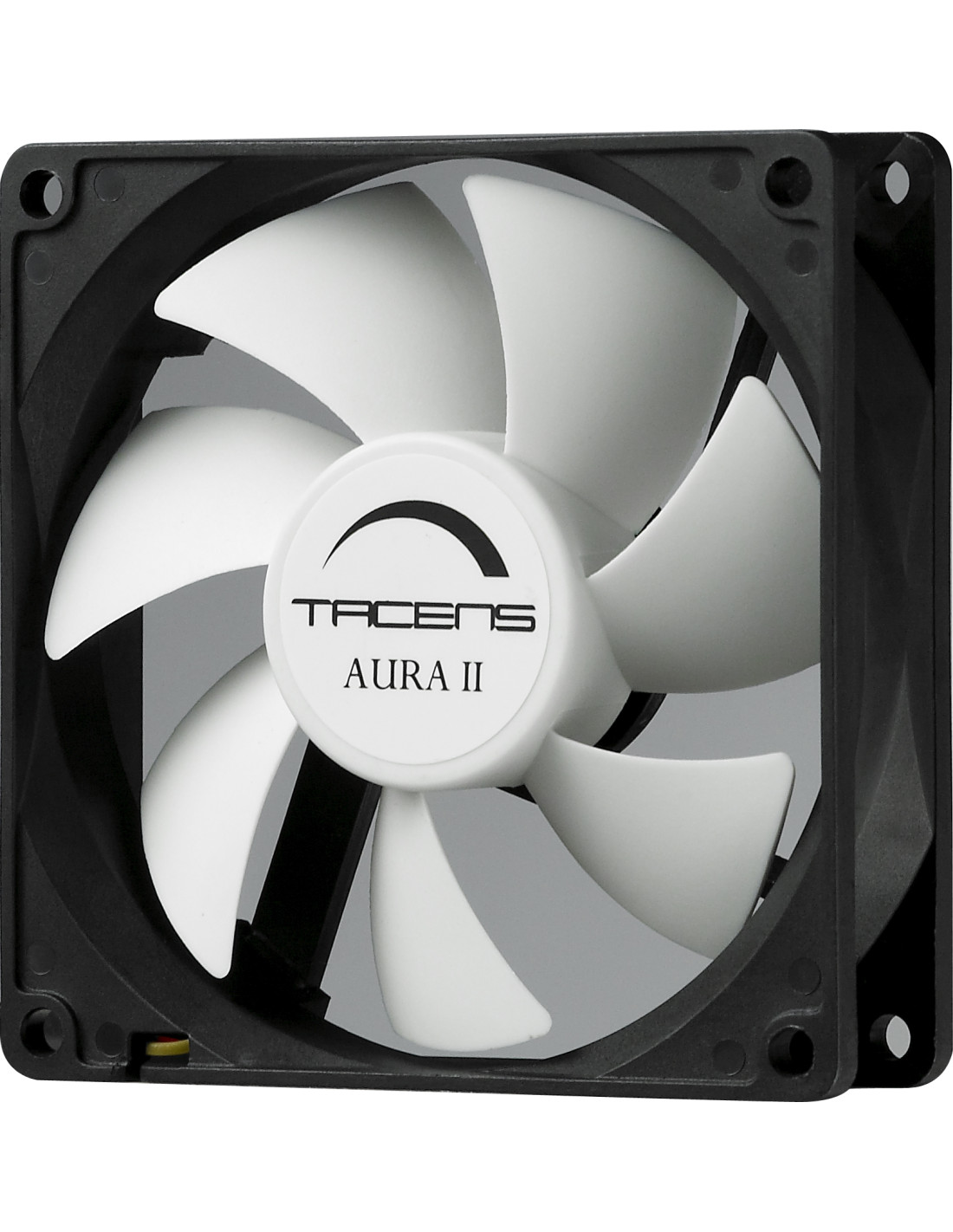
AURAII9
| Weight | 9g 89 |
|---|---|
| Dimensions | 90x90x25mm |
| Speed | 1350 RPM |
| Airflow | 33CFM |
| No. of blades | 7 |
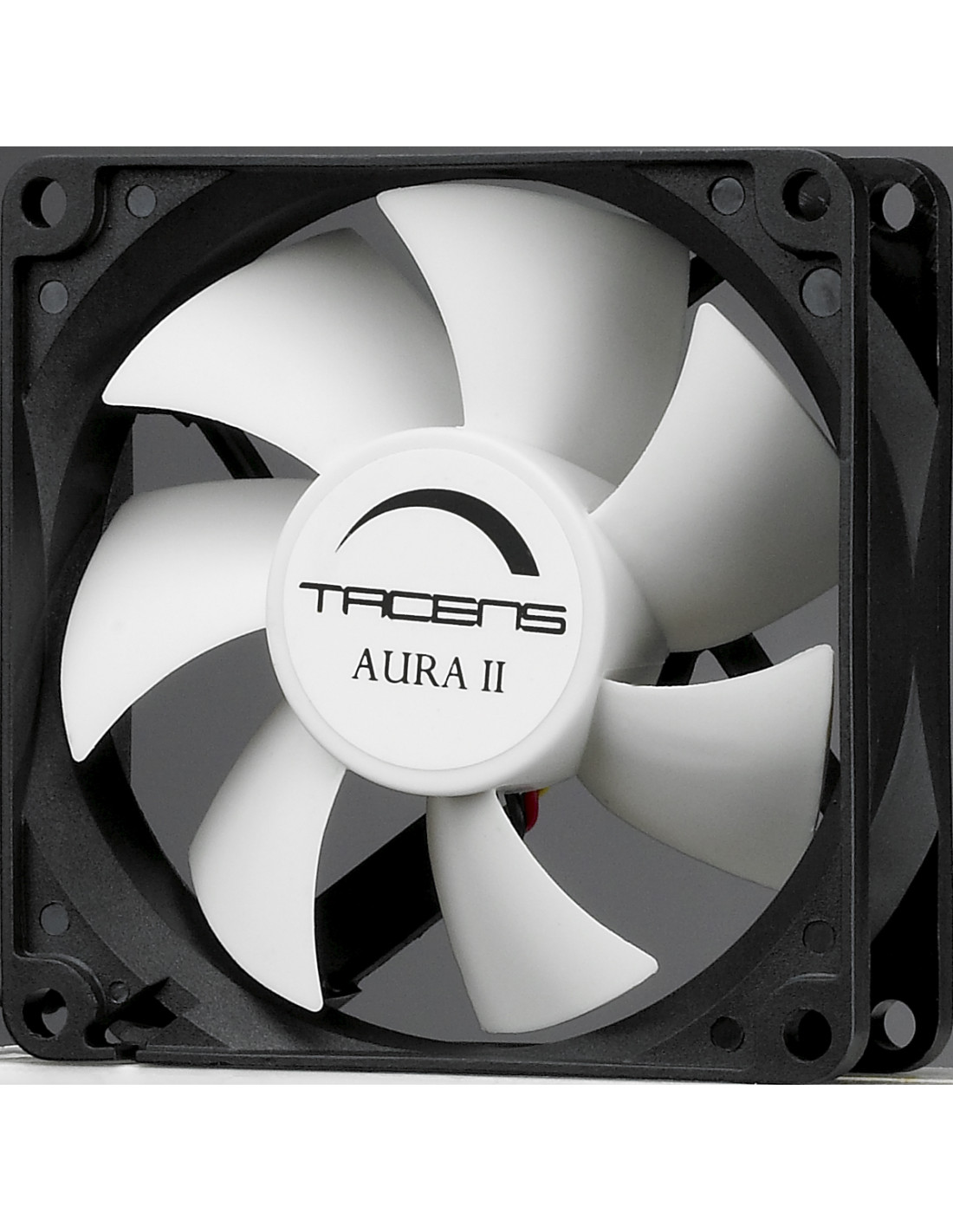
AURAII8
| Weight | 2g 64 |
|---|---|
| Dimensions | 80x80x25mm |
| Speed | 1500 RPM |
| Airflow | 25CFM |
| No. of blades | 7 |
Frequently asked questions
Is a 140 mm fan or a 120 mm fan better for a compact case?
A 140 mm fan moves a greater volume of air at fewer revolutions per minute, achieving quieter operation at an identical airflow to a 120 mm fan. However, in compact chassis the 120 mm standard, such as the AF12, offers greater physical compatibility with the case and adjacent coolers.
How many dBA are considered silent for case cooling?
A noise level below 18 dBA is practically inaudible at a distance of 50 cm. Units with 14 dBA, such as the 80 mm AF8 or the 120 mm AF12, keep acoustic noise to a minimum within the working environment.
Can case fans be replaced with radiator fans?
It is not advisable to do so directly without checking the static pressure. Radiators require fans with high mmH2O figures to overcome the resistance of the cooling fins, whereas for the case itself airflow in CFM generally takes priority.
The best: Adding between 1 and 2 fans of 120 mm or 80 mm optimises the thermal flow, reducing internal temperatures by up to 12 °C in cases of less than 25 litres.
The worst: Compact cases restrict the use of 140 mm fans and require the 25 mm thickness to be measured precisely to avoid internal collisions.
Buy it if: You have a compact-form-factor system with components exceeding 150 W of power draw and you need to reduce temperatures without increasing noise.
Don't buy it if: Your chassis already has a balanced positive pressure and stable CPU and GPU temperatures below 65 °C under maximum load.