
Shopping Cart
There are no more items in your cart
 Español
 English
 Português PT
 Français
 Italiano
 Deutsch
 اللغة العربية
In summary: The typical weight of a sturdy gaming PC case ranges from 2.5 kg to 4.5 kg empty for compact and standard mid-tower formats made of SPCC steel, reaching between 7 kg and 12 kg once all internal components are fitted.
Table of contents
- How much weight is normal for a PC case, empty and fully built?
- What factors determine the strength and weight of the chassis?
- What is the relationship between steel thickness and structural rigidity?
- How does cooling affect the structure of the chassis?
- Technical criteria for choosing a chassis based on its strength
- How to calculate the total weight of a built PC?
- Technical comparison of chassis by format and weight
- What common mistakes are made when assessing the weight of a case?
- Frequently asked questions about weight and gaming chassis
How much weight is normal for a PC case, empty and fully built?
The standard range for an empty mini-tower or mid-tower case made from commercial steel lies between 2,690 g and 3,910 g. This weight guarantees sufficient rigidity to absorb the mechanical vibrations generated by fans spinning at 1,200 RPM or hard drives at 7,200 RPM.
When a complete configuration is installed, the total weight of the system increases considerably:
- Empty chassis: from 2.7 kg to 3.91 kg.
- Standard ATX power supply: between 1.3 kg and 1.8 kg.
- Motherboard with heatsinks: between 0.8 kg and 1.2 kg.
- Dedicated graphics card with a 2- or 3-fan cooler: between 0.9 kg and 1.9 kg.
- Air CPU cooler or liquid cooling: between 0.5 kg and 1.4 kg.
- Storage and cabling: from 0.3 kg to 0.7 kg.
The total operating weight of a functional gaming computer typically settles between 6.5 kg and 11 kg.
What factors determine the strength and weight of the chassis?
The durability and sturdiness of a chassis depend directly on the manufacturing material, the sheet-metal folding techniques and the distribution of the anchor points for heavy components.
What is the relationship between steel thickness and structural rigidity?
The industry standard uses commercial cold-rolled steel (SPCC). A 0.5 mm thick sheet offers an optimal compromise between lightness and torsional strength in compact structures measuring 330 mm to 450 mm in length. Perimeter reinforcements and folds along the internal edges prevent the chassis from flexing when supporting ATX power supplies weighing over 1,500 g.
How does cooling affect the structure of the chassis?
Cooling support dictates the panel perforations and the weight of the case:
- 120 mm fans: The most common size on the market, offering an optimal balance between airflow and noise levels.
- 140 mm fans: They move more air volume at lower revolutions than a 120 mm unit, making them quieter for the same thermal flow.
- Airflow (CFM): Measures the volume of air moved in cubic feet per minute.
- Static pressure (mmH2O): The pressure the air exerts against restrictions; a high mmH2O value is essential for pushing through dense dust filters and radiators.
- Noise level (dBA): A-weighted sound level; keeping it below 25 dBA ensures quiet operation.
Technical note: Airflow (CFM) and static pressure (mmH2O) are not interchangeable; a fan with high CFM but low mmH2O loses performance when placed in front of a restrictive filter or a radiator.
Technical criteria for choosing a chassis based on its strength
Before selecting a case, specific physical parameters must be verified to ensure the structure can support the intended hardware:
- ATX power supply compatibility: Check that the bay accommodates standard ATX PS/2 or PS/3 power supplies without straining the lower bay.
- Storage bay layout: Ensure firm support for 3.5" HDD mechanical drives (which weigh around 500 g each) and 2.5" SSD drives (approximately 50 g each).
- Cooling capacity: Allow space for at least 2 or 3 120 mm units at the front and 1 120 mm unit at the rear to generate continuous positive airflow.
- Accessible front connectivity: Provide high-speed USB 3.0 ports and HD Audio connections on the top or front panel to avoid mechanical strain on the structure.
- Portability and reinforcements: If you expect to move the system frequently, look for structures with an integrated carry handle designed to bear loads above 8 kg without deforming.
How to calculate the total weight of a built PC?
To size the final weight of a gaming system built in a sturdy Tacens chassis, you must add up the individual components with their certified mass values.
For example, a 3.91 kg 2SAGITTA20W chassis plus a Radix range power supply with Gold certification weighing 1.45 kg, a 0.95 kg motherboard, a 1.20 kg graphics card, a 0.65 kg cooler and 0.34 kg of drives gives: 3.91 kg + 1.45 kg + 0.95 kg + 1.20 kg + 0.65 kg + 0.34 kg = 8.50 kg total built weight.
If you opt for a portable configuration, the calculation changes:
For example, a 2.73 kg FORTISII chassis + 1.35 kg power supply + 0.80 kg motherboard + 0.75 kg graphics card + 0.45 kg cooling = 6.08 kg, which allows for comfortable transport via its structural handle.
Technical comparison of chassis by format and weight
The following table compares the physical specifications, weight and cooling capabilities of different chassis models:
| Model | Case weight | Dimensions (mm) | Format | Fan capacity | Internal bays | Front connectivity |
|---|---|---|---|---|---|---|
| IMPERATORII | 2,690 g (2.69 kg) | 378 × 428 × 193 mm | Mid-tower | Up to 5x 120 mm | 2x 3.5" HDD + 2x 2.5" SSD | USB 3.0 x1 / USB 2.0 x2 / HD Audio + Mic |
| 2AEROM | 2.70 kg (2,700 g) | 330 × 189 × 380 mm | Small tower | Front 3x 120 mm / Rear 1x 120 mm | 1x 3.5" HDD / 3x 2.5" SSD | USB 3.0 x1 / USB 2.0 x2 / HD Audio + Mic |
| FORTISII | 2.73 kg (2,730 g) | 384 × 185 × 320 mm | Mini-tower | Front 1x 120 mm / Rear 1x 120 mm | Standard ATX support | USB 3.0 x1 / USB 2.0 x1 / HD Audio + Mic |
| 2AERO | 3.02 kg (3,020 g) | 342 × 186 × 414 mm | Semi-transformer | Front 3x 120 mm / Rear 1x 120 mm | 1x 3.5" HDD / 4x 2.5" SSD | USB 3.0 x1 / USB 2.0 x2 / HD Audio + Mic |
| NOVAX550BR | 3,437 g (3.44 kg) | 356 × 166 × 275 mm | Mini-tower | Rear 1x 80 mm | 2x 3.5" HDD + 2x 2.5" SSD | USB 3.0 x1 / USB 2.0 x1 / HD Audio + Mic |
| 2SAGITTA20W | 3.91 kg (3,910 g) | 450 × 190 × 340 mm | Mid-tower | Top 2x 120/140 mm / Bottom 2x 120 mm / Rear 1x 120 mm | 1x 3.5" HDD / 2x 2.5" SSD | USB-C x1 / USB 3.0 x1 / USB 2.0 x1 / Audio |
What common mistakes are made when assessing the weight of a case?
- Assuming that more weight always means better cooling: A heavy chassis with solid front panels restricts air intake compared with a 2.7 kg case with a mesh front for 3 120 mm fans.
- Ignoring the accumulated weight when transporting: Building a system in a chassis over 4 kg to take to events produces setups over 9 kg, where a 2.73 kg model with a handle such as the FORTISII is 30% more manageable.
- Not checking 140 mm fan compatibility: Fitting 140 mm fans onto 120 mm-only mounts can strain the sheet metal and create 1 mm to 2 mm gaps that cause vibration noise.
- Forgetting the power supply support: Fitting heavy power supplies without checking for standard ATX PS/2 or PS/3 chassis support can bow the lower rear area if the metal lacks reinforcing folds.
Products mentioned
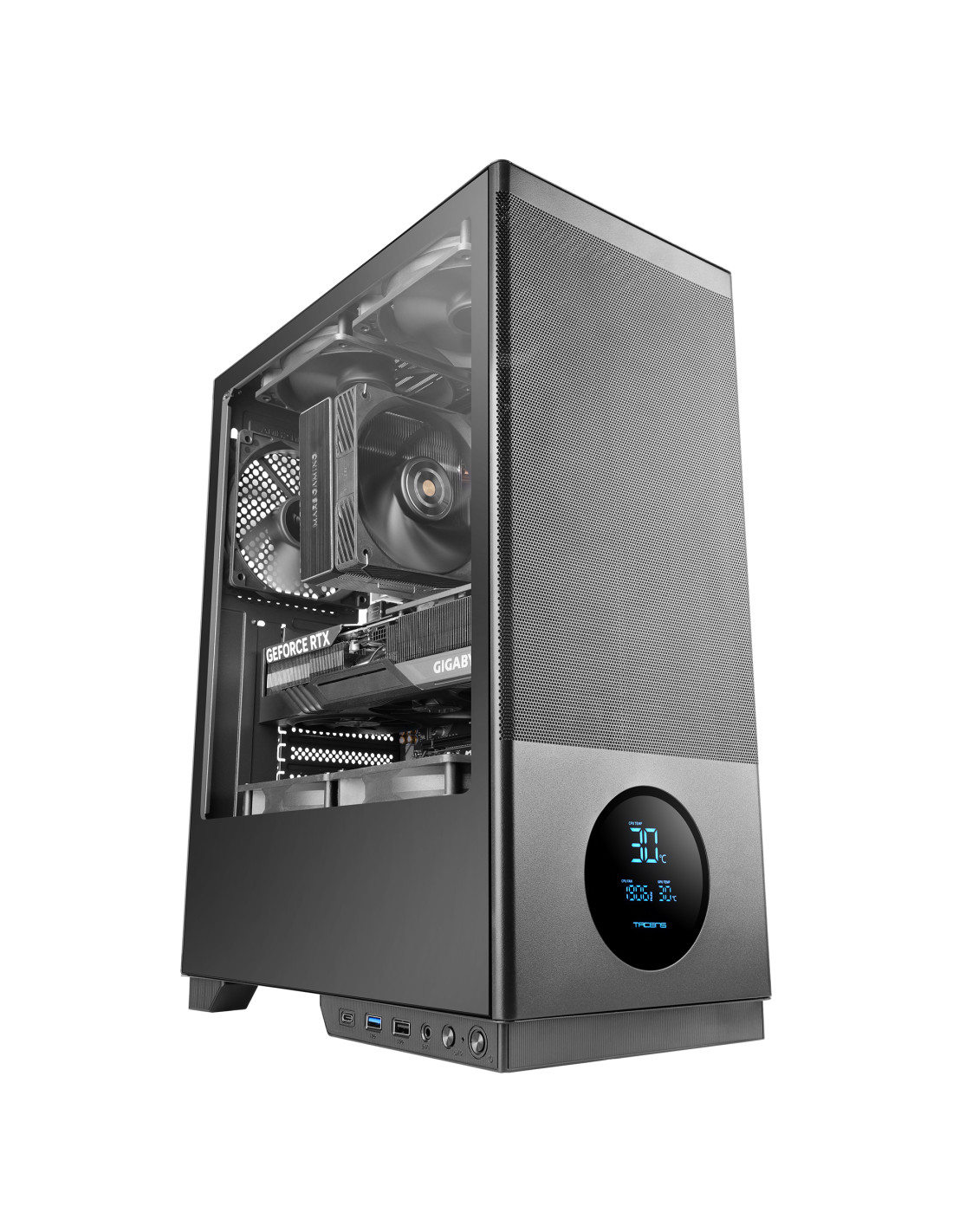
SAGITTA20
| Weight | 3.91Kg |
|---|---|
| Dimensions | 450x190x340mm |
| Size | Mid-tower |
| Fan capacity | Top 2x 120mm or 2x 140mm / Bottom 2x 120mm / Rear 1x 120mm |
| Ports | USB3.0 x1 / USB2.0 x1 / USB-C x1 (USB3.0 data transfer speed) / HD Audio + Mic (combined) |
| Power supply support | ATX |
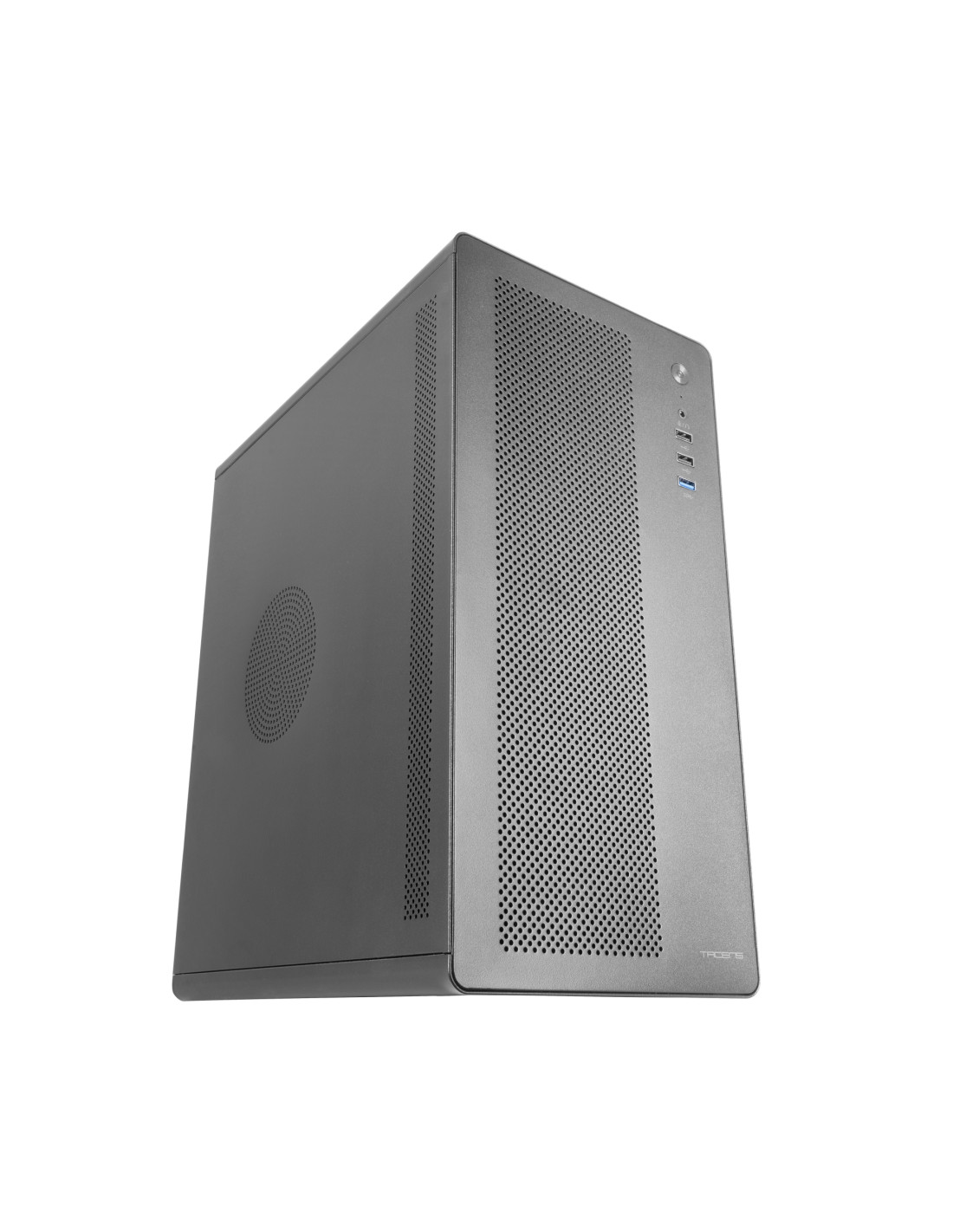
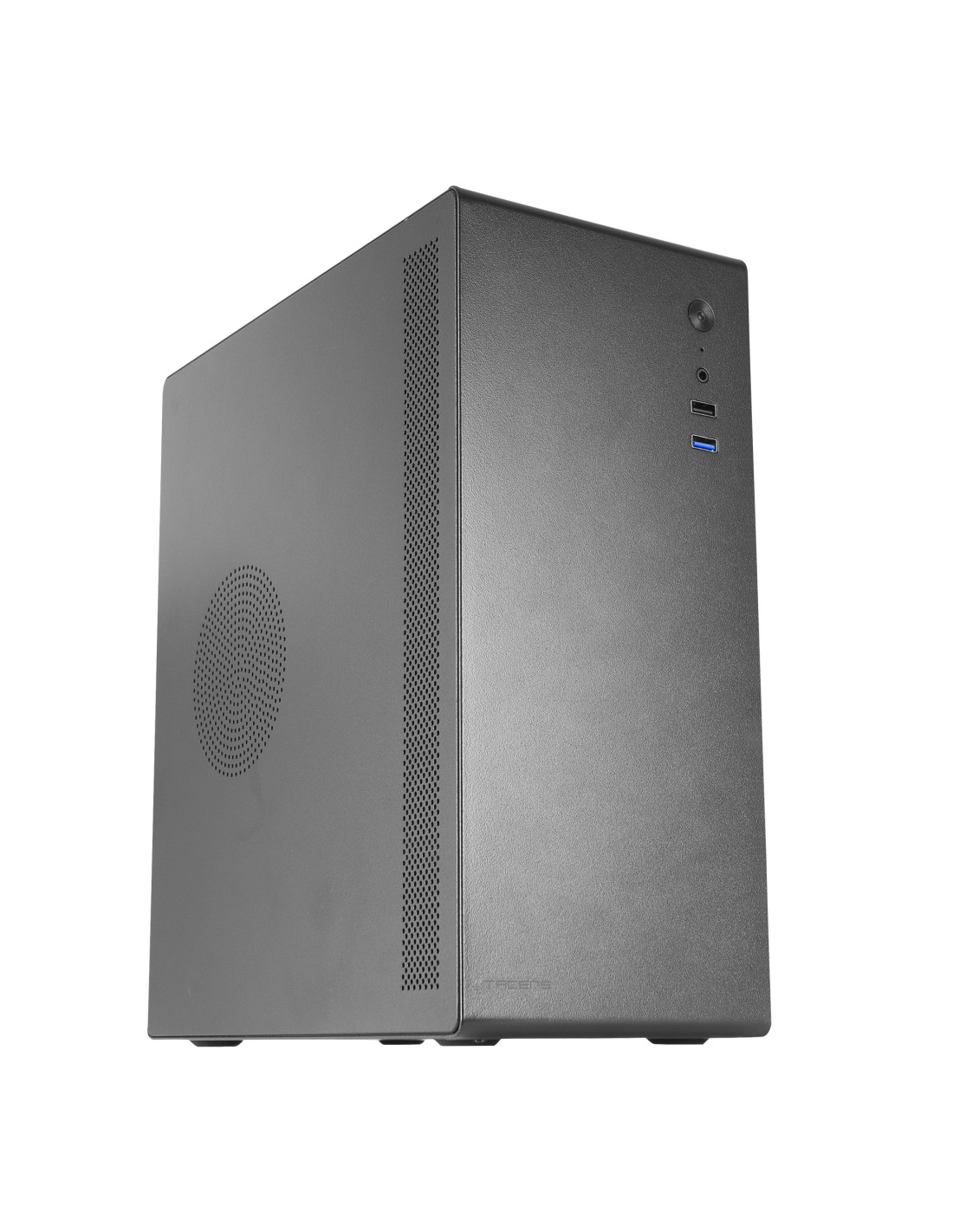
NOVAX550BR
| Weight | 3437g |
|---|---|
| Dimensions | 356x166x275mm |
| Size | Mini-tower |
| Fan capacity | Rear: 1x 80mm |
| Ports | USB3.0 x1 / USB2.0 x1 / HD Audio + Mic (combined) |
| Power supply support | ATX |
Frequently asked questions about weight and gaming chassis
Is it bad if a PC case weighs less than 3 kg?
No, a weight between 2.69 kg and 3.02 kg in compact formats indicates a chassis optimised for space and transport without compromising structural strength. Rigidity depends on the folds in the 0.5 mm steel, not merely on the raw thickness of the sheets.
Which fan is most efficient at reducing noise in a mid-tower?
140 mm fans move an equivalent airflow (in CFM) at lower revolutions per minute than 120 mm fans. This keeps the overall noise level of the system below 20 dBA at half load.
Can a powerful ATX power supply be fitted in a lightweight chassis?
Yes, models from 2.70 kg to 3.91 kg such as the 2AEROM or 2SAGITTA20W are compatible with standard ATX format power supplies, such as the high-efficiency units in the Radix range with Gold certification.
The best: Excellent balance between sheet-metal structural rigidity and contained weights of 2.69 kg to 3.91 kg, with full support for ATX power supplies.
The worst: The lighter 2.7 kg options reduce the space for large liquid cooling radiators compared with models over 450 mm.
Buy it if: You are looking to build a sturdy gaming system that is easy to move and supports multiple 120 mm or 140 mm fans.
Don't buy it if: You need to fit configurations with triple 360 mm radiators or large E-ATX format motherboards.